Why Yulu Used Debt to Build 150,000 More EVs
Table of Contents
Yulu raised $93 million this month. The number worth looking at is not $93 million.
It is the $30 million of it that arrived as debt.
Yulu is a Bengaluru company that rents small electric vehicles to delivery riders. It runs about 50,000 of them today and wants 200,000 within two years.
That is 150,000 more vehicles to buy. You do not buy 150,000 vehicles by selling shares in your company.
What Yulu Actually Does
Before the capital structure, the business, because it explains everything that follows.
Yulu owns a fleet of small electric two-wheelers. Delivery riders rent them, usually by the day or the month, and use them to deliver food and groceries. The company says its vehicles power around 750,000 deliveries a day.
Riders do not buy the scooter. They rent it. Yulu owns the asset and collects a recurring payment against it.
Batteries are swapped rather than charged, through Yuma Energy, a joint venture with Magna. A rider pulls in, exchanges a drained battery for a charged one, and leaves. The vehicle keeps earning instead of sitting on a charger.
Hold that structure in mind. Yulu owns a physical thing. Somebody pays to use it every day. That combination is what makes the rest of this possible.
The Split
The Series C, announced on 12 August 2026, broke down like this.
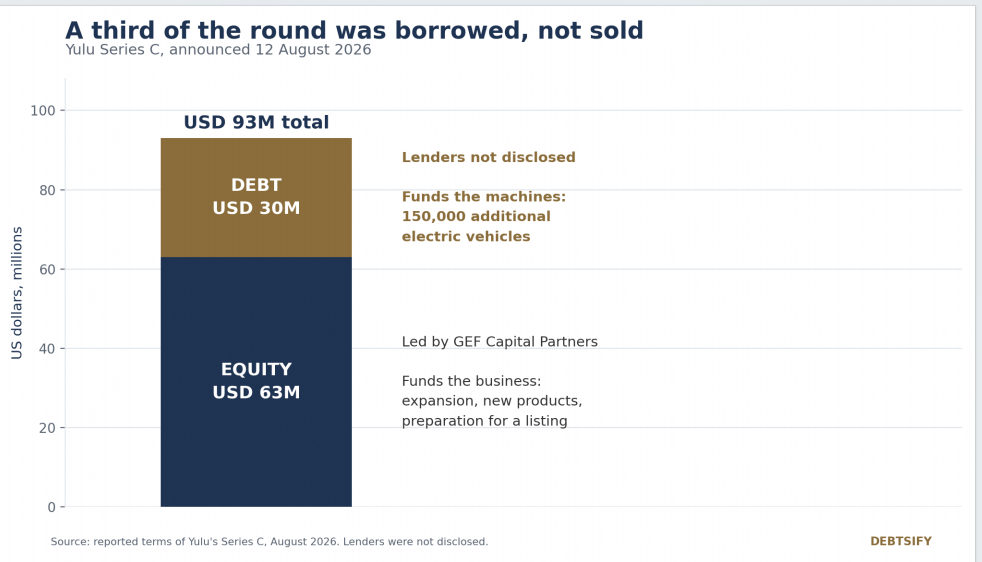
| Component | Amount | Led by |
|---|---|---|
| Equity | $63 million | GEF Capital Partners |
| Debt | $30 million | Lenders not disclosed |
| Total | $93 million |
Roughly a third of the round is borrowed.
The company says the money takes its active fleet from about 50,000 vehicles to 200,000 over two years, alongside new urban mobility use cases and preparation for a possible listing.
Two very different things are being funded there. One is a business. The other is a pile of scooters.
Why a Scooter Can Be Borrowed Against and Software Cannot
This is the whole idea, and it is simpler than it sounds.
A lender is not really asking whether your company is good. A lender is asking two questions. Will the cash arrive to repay me, and if it does not, what is left that I can recover?
An electric scooter answers both.
It has a serial number, so it can be identified. It has a resale value, so it can be recovered and sold. And it has a rider paying to use it today, so there is observable cash attached to that specific asset.
Now try the same exercise on a software company. What is the serial number of a brand? What is the resale value of a codebase whose engineers have left? There is often nothing to recover, which is why early-stage software gets funded with equity and not credit. Equity investors accept that everything might go to zero. Lenders do not.
The financeability of a business is not about how good it is. It is about how much of it is made of things.
Yulu is made of things. So a third of its round could be borrowed.
What the Other Route Would Have Cost
Consider what happens if Yulu funds the entire $93 million with equity instead.
The round is reported to value the company at roughly $170 million post-money. On those numbers, raising the additional $30 million as equity rather than debt would mean issuing something in the region of another 17% of the company.
Seventeen percent of a business, given away permanently, to buy vehicles that will be worn out and replaced within a few years.
Illustrative arithmetic based on the reported post-money valuation. Actual dilution depends on the round's precise structure and pre-money terms.
That is the trade in one sentence. Debt costs interest for a period. Equity costs ownership forever. When the thing being bought has a finite life and its own resale value, paying for it with permanent ownership is the more expensive of the two options by a wide margin.
The Numbers Behind the Decision
The debt tranche is only available because the operating business supports it.
| Metric | FY2024 | FY2025 |
|---|---|---|
| Revenue from operations | ₹120 crore | ₹237.4 crore |
| Net loss | About ₹143 crore | ₹126 crore |
Revenue nearly doubled. The loss narrowed by about 12%. The company has reported positive EBITDA from April 2025 and says revenue grew roughly sevenfold between FY2023 and FY2026.
A lender looking at that sees revenue that is growing, losses that are shrinking, and operating profitability arriving. Combined with a fleet that can be identified and recovered, that is a financeable position.
Two years earlier, with a smaller fleet and a wider loss, the same company would probably have been offered equity and nothing else.
The instrument available to you changes as the business changes. Most founders raise the way they raised last time and never re-test whether the answer has moved.
The Part That Makes This Urgent
Yulu has raised more than $228 million since it started, including an $82 million Series B led by Magna in September 2022 and about $19.25 million from Magna and Bajaj in February 2024.
This round is reported at roughly $170 million post-money.
The company is currently valued at less than the total capital that has been put into it.
That is not a judgement on Yulu, which is growing quickly and approaching profitability. It is arithmetic, and it is common among asset-heavy businesses that funded their assets with equity during a period when equity was cheap and plentiful.
It also explains the discipline in this round. Both Bajaj Auto and Magna, existing strategic investors, waived their pre-emptive rights and did not participate. When your last two hundred million of equity has produced a valuation below its own cost, borrowing the next thirty is not a clever financial trick. It is the obvious thing to do.
Which Costs Belong on Which Instrument
The Yulu structure generalises. Most businesses have both kinds of cost sitting in the same plan and fund them with the same instrument.
| What you are funding | Right instrument | Why |
|---|---|---|
| Vehicles, machinery, equipment | Debt secured on the asset | Identifiable, recoverable, generates its own cash |
| Inventory for a known selling season | Structured credit | Converts to cash on a knowable date |
| A receivable settling in 90 days | Receivables financing | Underwritten on your customer's credit |
| Hiring against a signed contract | Structured credit | Repayment source is the contract |
| Entering a new market with no revenue yet | Equity | No cash flow, nothing recoverable |
| Building the product itself | Equity | The risk is whether it works at all |
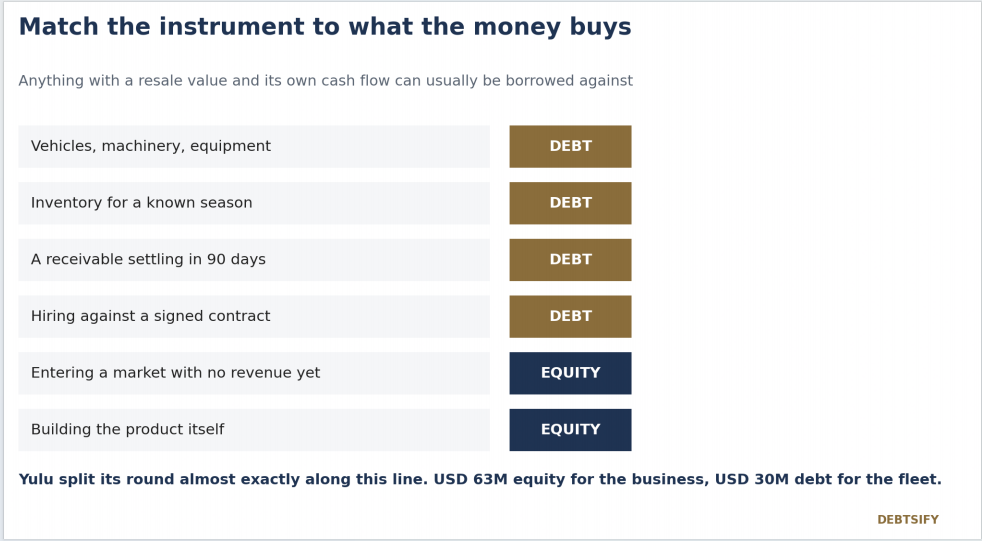
The mistake is not raising equity. It is raising equity for row one when row one is the easiest thing in the business to borrow against.
Look at Yulu's split again with this table in mind. Sixty-three million of equity for the business, the expansion, the new products. Thirty million of debt for the machines. It matches almost exactly.
Where Debtsify Fits
Debtsify arranges structured credit for Indian companies that already generate revenue. Facilities run from ₹5 crore to ₹100 crore, fully non-dilutive. No shares, no warrants, no conversion rights, no board seats.
What we underwrite. Revenue quality, gross margin, customer concentration, and how reliably you collect. Triage runs on two documents: a one-page corporate snapshot and six months of operating bank statements. Statements show what happened. Projections show what somebody hopes will happen.
What our timeline is. Debtsify operates on a 48 to 72 hour mandate, with funds reaching the client's primary treasury typically by Day 4.
What we are not. Not a bank. Not registered with the RBI as an NBFC. Not the lender ourselves. We arrange and structure capital from third-party providers including RBI-registered NBFCs, alternative investment funds, family offices, and other private lenders.
What we will tell you plainly. The most common reason we decline an enquiry is that revenue is too small or too unpredictable to service repayment in a flat case, with no new customers assumed. If that is your business today, credit is the wrong instrument and equity is the right one. Yulu two years ago would very likely have been a decline. Yulu today is a different conversation, and that is the point.
Debtsify in Numbers
Debtsify's mandate operates on a 48 to 72 hour timeline, with funds reaching the client's primary treasury typically by Day 4.
The most common reason we decline an enquiry is that revenue is too small or too unpredictable to service repayment in a flat case.
We arrange facilities across manufacturing and industrials, D2C and consumer, SaaS and technology, and services, sized between ₹5 crore and ₹100 crore.
Frequently Asked Questions
- How much did Yulu raise and how was it structured?
Yulu raised $93 million in a Series C announced on 12 August 2026. The round comprised $63 million in equity led by GEF Capital Partners and $30 million in debt. The lenders were not disclosed. The company has raised more than $228 million since inception.
- Why did Yulu take debt instead of raising more equity?
Because the money is buying vehicles. An electric scooter is identifiable, has a resale value and generates rent from a rider, which makes it something a lender can underwrite. Funding an asset with permanent equity costs ownership forever for something with a finite life.
- How many vehicles does Yulu operate?
Yulu runs about 50,000 active two-wheelers and plans to quadruple that to 200,000 over two years, an increase of roughly 150,000 vehicles. The company says its fleet powers around 750,000 deliveries a day. Batteries are swapped rather than charged, through Yuma Energy, its joint venture with Magna.
- Is Yulu profitable?
Not yet at the net level, but improving. FY2025 revenue from operations was ₹237.4 crore, nearly double the ₹120 crore of FY2024, while net loss narrowed about 12% to ₹126 crore. The company has reported positive EBITDA from April 2025.
- What can other founders learn from how Yulu funded this?
That the instrument should match what the money buys. Assets with resale value and attached cash flow can be borrowed against. Product development and market entry cannot. Most companies fund both with the same equity round and pay permanent ownership for temporary machines.
If You Are Buying Things, Stop Selling Shares
Yulu needs 150,000 more vehicles. It is borrowing for a large part of that, because vehicles are exactly the kind of thing lenders are willing to fund.
If your next plan involves buying inventory, machinery, equipment or fleet, the same logic applies to you at a smaller scale. Those are the most financeable line items in your business, and they are the ones founders most often pay for with equity.
About Debtsify
Debtsify is a private structured-credit and bridge-financing partner for high-growth Indian companies. It arranges ₹5 Cr to ₹100 Cr in 48 to 72 hours, 100% non-dilutive, with no equity, warrants, board seats, or collateral. It is not a bank, an NBFC-marketplace, or a loan aggregator. It is a capital partner.
Related reading
- How Can an Indian Startup Raise ₹10 Cr to ₹100 Cr Without Giving Away Equity?
- The $2 Billion Loan: What It Cost Ritesh Agarwal to Buy Back His Own Company
- Flipkart Raised $7 Billion in Equity. Walmart Borrowed $16 Billion to Buy It.
- Bridge Financing in India
Frequently Asked Questions
How much did Yulu raise and how was it structured?+
Why did Yulu take debt instead of raising more equity?+
How many vehicles does Yulu operate?+
Is Yulu profitable?+
What can other founders learn from how Yulu funded this?+
Ready to explore structured funding options?
Connect with Debtsify today to discover how custom venture debt and non-dilutive bridge capital can fuel your growth without equity dilution.